

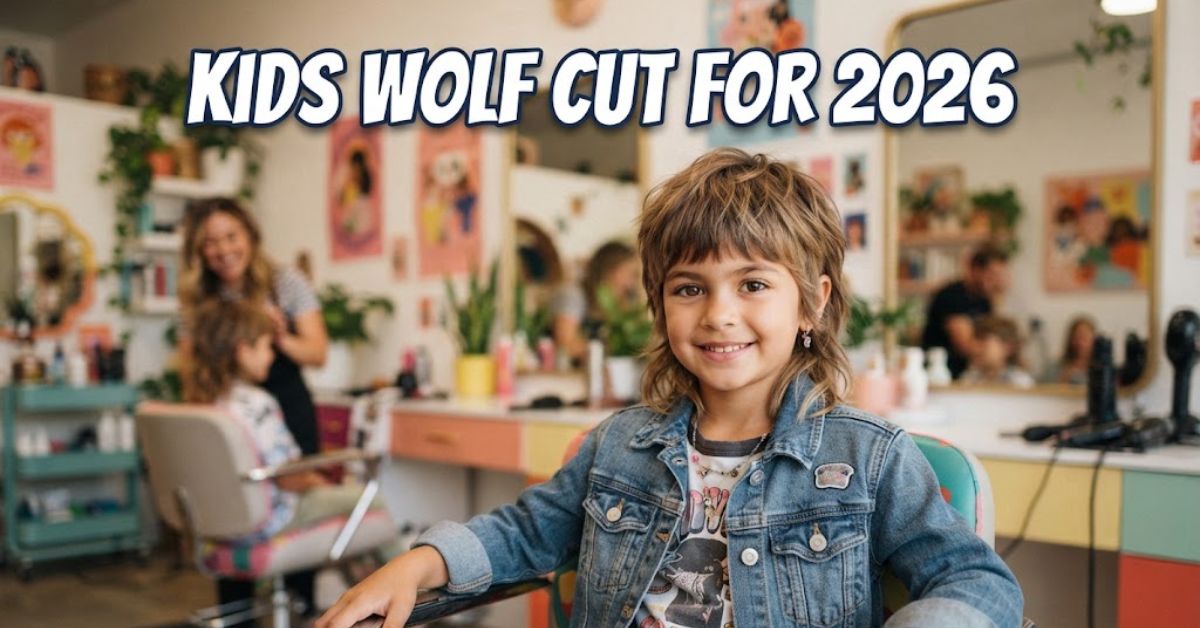
A kids wolf cut is a layered, textured haircut with short, choppy layers on top and longer, wispy lengths at the back. It works on boys and girls, and it suits most hair types when the stylist adjusts it for the child.
Parents like it for a simple reason. It looks stylish but forgiving. A messy morning does not ruin it, and a few extra weeks between trims barely shows.
This guide covers what the cut is, how it differs from similar styles, how to adapt it by age and hair type, and what to say in the salon chair. You will also get a 2-minute daily routine and a trim schedule you can actually follow.
What Is a Kids Wolf Cut?
A kids wolf cut is a hybrid of the shag and the mullet, scaled down and softened for children. It uses short layers around the crown, a fuller and more textured top, and longer lengths through the back and sides.
The cut became popular among teens and adults, then moved down to younger kids as parents saw how easy it was to live with.
Key features of a kids wolf cut:
- Short, choppy layers at the crown for lift and shape
- Longer, feathered lengths at the nape and sides
- Soft texture instead of sharp, clean lines
- Optional curtain bangs or a wispy fringe
- A lived-in, tousled finish
The “lived-in” part matters most. Current kids’ hair trends lean toward cuts that look natural and take little effort. The wolf cut fits that well because it looks best slightly undone.
Kids Wolf Cut vs. Shag vs. Mullet: Know the Difference

Parents often use these three names interchangeably, and stylists do not. Knowing the difference helps you get the cut you picture.
| Feature | Kids Wolf Cut | Shag | Mullet |
| Layering | Heavy at crown, long at back | Even layers throughout | Short top and sides, long back |
| Contrast | Medium | Low | High |
| Texture | Choppy and wispy | Soft and feathered | Clean or blended |
| Bangs | Often curtain or wispy | Common | Rare |
| Best for | Active, expressive kids | Kids who want soft movement | Kids who want a bold look |
The short version:
- A shag has layers all over for gentle movement.
- A mullet has a sharp contrast between short front and long back.
- A wolf cut sits between them, with more volume on top than a shag and a softer back than a mullet.
If you want a milder version, ask for a “soft wolf cut” or a “modern shag.” If you want drama, ask for more disconnection between the top and back layers.
Kids Wolf Cut by Age: Toddler to Teen
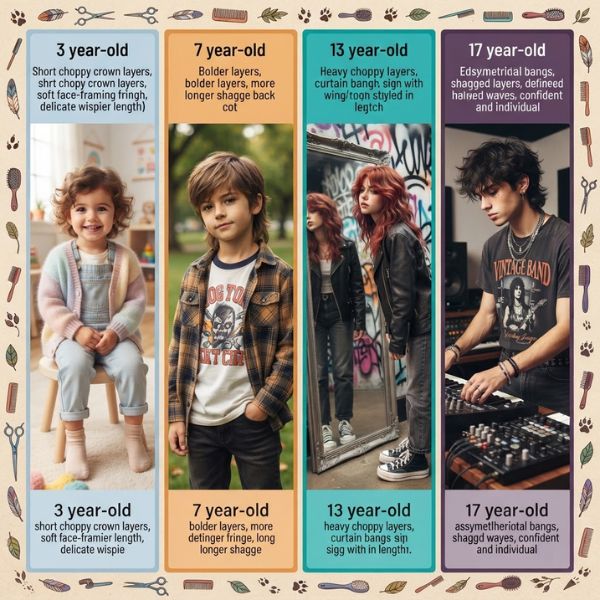
A good kids wolf cut changes with age. A three-year-old and a fifteen-year-old need very different cuts, even if both are called “wolf.”
Three things shift as kids grow: patience in the chair, hair density, and how much styling the child will do alone. Plan the cut around those, not just the photo.
Toddler Wolf Cut (Ages 3–5)

Toddler hair is usually fine, soft, and fast-growing in patches. It also sits still for about ten minutes.
What works best:
- Short to medium length, ideally just past the ears at the back
- Soft layers only, with no razor work
- Light face-framing pieces instead of heavy bangs
- A quick cut, ideally under 20 minutes
Ask the stylist to keep the layers longer than they would for an adult. Very short layers on fine toddler hair can stick up and look uneven rather than textured.
Bring a snack, a tablet, or a favorite toy. A relaxed child makes for a cleaner cut, and a clean cut grows out better.
School-Age Wolf Cut (Ages 6–12)

This is the sweet spot for the kids wolf cut. Children in this range have denser hair, can sit longer, and often have strong opinions about their look.
What works best:
- Medium length with visible crown layers
- Textured ends that can handle playground wind
- Curtain bangs or a side-swept fringe if the child likes them
- A shape that survives a ponytail or a clip
Active kids need hair that can be pushed back for sports. Ask for layers that are not so short they fall out of a hair tie. A good rule is that the shortest layer should still reach the cheekbone when pulled forward.
Let your child pick the photo. Kids in this age group often care a lot about the final look, and a cut they chose is a cut they will style.
Teen Wolf Cut (Ages 13–16)

Teens want the full version. That usually means more contrast between layers, longer back lengths, and heavier texture.
What works best:
- Strong crown layering with a longer, wispy back
- Razor texturizing for a lived-in finish
- Bangs of any style, from curtain to micro
- Optional color accents, such as subtle highlights
Teens can handle products and heat, so the cut can be more styled. Still, check school dress codes before going very dramatic, especially with length and color.
Kids Wolf Cut by Hair Type

The same cut looks different on every texture. A stylist should adjust the layering based on how your child’s hair behaves, not just how it looks wet.
Straight Hair Kids
Straight hair shows every line, so the layers need to be blended well. Without texture, the cut can look flat or heavy.
Tips for straight hair:
- Ask for point cutting to soften the ends
- Choose slightly shorter crown layers for lift
- Use a light sea salt spray or texturizing mist on damp hair
- Avoid very thin, stringy ends
Straight hair holds shape well, which means a cut that is slightly off will show. Pick a stylist who is confident with scissor-over-comb or razor work.
Wavy Hair Kids
Wavy hair is the easiest match for a kids wolf cut. The layers add movement, and the natural wave fills in the texture.
Tips for wavy hair:
- Ask for long layers that follow the wave pattern
- Skip heavy thinning, which can cause frizz
- Air dry or diffuse on low heat
- Use a leave-in conditioner to keep waves defined
Most kids with wavy hair can leave the house with almost no styling. That is the real payoff of this cut.
Curly Hair Kids
Curly hair can look stunning in a wolf cut, but it needs care. Layers that are too short or too sharp can create a triangle shape or bulky sides.
Tips for curly hair:
- Book with a stylist who knows curl-specific cutting
- Ask for the cut to be done dry or on dry curls when possible
- Keep layers longer to protect curl pattern
- Avoid heavy thinning shears
- Use a curl cream and scrunch, then air dry
Curly hair also shrinks as it dries. A layer that looks right when wet may pop up two inches shorter. A good stylist plans for that.
How to Talk to Your Kid’s Stylist
Many bad haircuts come from unclear instructions, not bad stylists. A “wolf cut” can mean five different things depending on who you ask.
Use this simple approach:
- Bring two or three photos. Show front, side, and back views if you can.
- Name the length. Say “just past the ears” or “to the collarbone,” not “medium.”
- Describe the layers. Say “short layers at the crown, longer at the back.”
- Mention the bangs. Choose curtain, wispy, side-swept, or none.
- Share lifestyle details. Mention sports, ponytails, or school rules.
A script you can use:
“We’d like a soft kids wolf cut. Short, choppy layers on top for volume, and longer, wispy length at the back. No sharp lines. He plays soccer, so it needs to dry easily and stay out of his eyes.”
Ask one question before the cut starts: “How will this grow out?” A good stylist will tell you honestly, and that answer sets realistic expectations for the weeks ahead.
Daily Styling for Kids: The 2-Minute Routine
The best kids wolf cut is one that fits a school morning. This routine takes about two minutes and works for most hair types.
The 2-minute routine:
- Dampen the hair. Use a spray bottle with water, not a full wet-down. (20 seconds)
- Add a small amount of product. Use a pea-sized amount of leave-in cream for wavy or curly hair, or a texturizing spray for straight hair. (20 seconds)
- Shape with fingers. Scrunch the top, and push the front to one side or part it in the middle. (40 seconds)
- Dry or air dry. Use a blow dryer on low for 30 seconds if there is time, or skip it. (30 seconds)
- Finish. Tousle the ends, and tuck behind the ears if needed. (10 seconds)
Wide-tooth combs and soft brushes work better than fine-tooth combs, which can pull layers out of shape and cause frizz. Detangle first, then style.
Keep products gentle. Children’s scalps are more sensitive than adults’, so choose fragrance-light, kid-friendly formulas.
Read More: Wolf Cut vs Shag: How to Tell Them Apart (2026 Guide)
Kids Wolf Cut Maintenance: The 4-6 Week Rule
The kids wolf cut is low effort day to day, but it is not no-maintenance. The shape depends on layers staying balanced, and kids’ hair grows about half an inch per month.
The rule: book a trim every 4 to 6 weeks.
At 4 weeks, the nape and ears start to lose their shape. By 6 weeks, the crown layers grow heavy and the cut starts to look like a regular long haircut.
Shorter wolf cuts need trims closer to 4 weeks. Longer ones can stretch toward 6.
What Happens If You Skip
Skipping trims does not ruin the cut, but it changes it. Here is what usually happens:
- Weeks 6 to 8: Layers blur together, and volume drops.
- Weeks 8 to 10: The back gets long and heavy, and the style looks less intentional.
- After 10 weeks: Split ends appear, tangles increase, and you may need a full reshape instead of a quick trim.
A reshape costs more time and may mean cutting more length. A short maintenance trim is cheaper and faster for both you and your child.
The Maintenance Trim Script for Parents
You do not need a full consultation each time. Use this quick script:
“Just a maintenance trim. Please keep the same layers and length, and take off about half an inch. Tidy the nape and around the ears, and refresh the bangs.”
Maintenance trim checklist:
- Ask for the nape and sides to be cleaned up
- Request a quarter to half inch off the ends
- Have the bangs or fringe refreshed
- Ask if any layers need softening
If your child is growing the cut out, say that clearly. Stylists will trim differently for “maintain” versus “grow out.”
Common Kids Wolf Cut Mistakes
Most problems come from small decisions, not big ones. Avoid these:
- Layers cut too short. They stick up, will not tie back, and take months to recover.
- Skipping the consultation. A quick “just a wolf cut” invites misreading.
- Over-thinning curly hair. This leads to frizz and weak curl definition.
- Ignoring the cowlick. A cowlick at the crown or front can push layers the wrong way.
- Using heavy adult products. Wax and strong gels weigh down fine kids’ hair.
- Forcing a style the child dislikes. Kids who do not want the cut will fight the routine.
- Using a razor on very fine toddler hair. This can create fuzzy, uneven ends.
- Waiting too long between trims. The shape fades, and the cut becomes harder to fix.
A good rule is to start slightly longer. You can always cut more, but you cannot add length back.
FAQ’s:
Is a wolf cut good for kids?
Yes. It is low-effort, forgiving, and adaptable to most ages and hair types when layers are kept soft.
What age can a child get a wolf cut?
Kids as young as three can have a soft version, as long as their hair is long enough to layer and they can sit still.
Is the kids wolf cut only for girls?
No. It works for boys and girls, and it is a popular unisex option in 2026.
Does a wolf cut work on straight hair?
Yes, with well-blended layers and a little texture spray. Straight hair needs more careful cutting to avoid a flat look.
Can curly hair get a wolf cut?
Yes. Choose longer layers and a stylist who understands curls to protect the pattern.
How often should a kid’s wolf cut be trimmed?
Every 4 to 6 weeks keeps the shape fresh. Shorter versions lean toward 4 weeks.
How long does it take to style a kids wolf cut each day?
About two minutes with a damp-hair spray, a light product, and finger styling.
How long does hair need to be for a wolf cut?
Usually at least chin or ear length. Shorter hair can work with a modified, cropped version.
What products are safe for kids’ wolf cuts?
Light leave-in cream, curl cream, or texturizing mist in gentle, fragrance-light formulas.
How do I grow out a kids wolf cut?
Skip the layering trims, and only clean up the ends and nape every 8 to 10 weeks.
Conclusion
A kids wolf cut gives children a modern, expressive look without a high-maintenance routine. The best results come from matching the cut to your child’s age, hair type, and lifestyle, then keeping it fresh with a trim every 4 to 6 weeks.
Bring clear photos, use the stylist scripts above, and start slightly longer if you are unsure. With a two-minute routine and a little planning, the kids wolf cut can stay easy, comfortable, and fun from morning to bedtime.